0% Complete
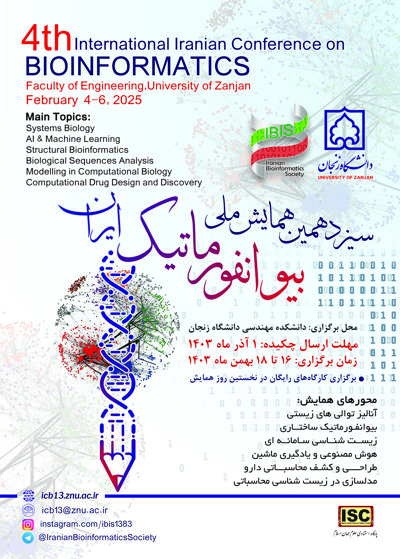
the 4th international edition and 13th Iranian Conference on Bioinformatics
international edition and Iranian Conference on Bioinformatics
صفحه اصلی
/
4th international edition and 13th Iranian Conference on Bioinformatics
Bioinformatics studies on S35K mutation on Mnemiopsin 2 photoprotein
نویسندگان :
ََAmirReza Mohammadi
1
Vahab Jafarian
2
Fatemeh Khatami
3
1- University of Guilan
2- University of Guilan
3- University of Guilan
کلمات کلیدی :
Bioinformatics،Bioluminescence،Homology Modeling،Mnemiopsin 2
چکیده :
Bioluminescence is the process where certain living organisms emit light. This phenomenon occurs in photoproteins when Ca²⁺ binds to their EF-hand loops. Mnemiopsin 2 is a Ca²⁺-regulated photoprotein that contains three EF-hand motifs capable of binding Ca²⁺. The coelenterazine-bound form is called a photoprotein, while the protein without coelenterazine is referred to as an apophotoprotein. The S35K mutation is analyzed using professional bioinformatics servers and resources. A BLAST search in the NCBI database identifies S35K as an optimal choice due to direct evolution. Multiple 3D models of the S35K-mutated Mnemiopsin 2 photoprotein are modeled using Modeller v10.4, and these structures are evaluated with parameters such as ERRAT, Verify3D, and Ramachandran score, all accessible via the SAVES website. The Chimera software calculates the RMSD score, which allows the identification of the most accurate and reliable structural model. The selected model undergoes further assessment with the VADAR server. The Expasy server calculates the hydropathy index (based on the Kyte & Doolittle protocol), molecular weight, and instability index. The results show no significant differences in hydrogen bond distances or folding patterns, including alpha helices, beta sheets, and coil percentages, compared to the wild-type Mnemiopsin 2 photoprotein. A detailed comparison performed using Chimera indicates no observable structural changes between the mutated and wild-type photoproteins. This comprehensive analysis suggests that the S35K mutation is non-destructive, and the protein likely retains functionality similar to the wild type, with no significant reduction in stability. Additionally, this mutation decreases the hydropathy of the protein, making it an intriguing candidate for further functional studies and potential biotechnological applications.
لیست مقالات
لیست مقالات بایگانی شده
A Novel Approach to Antimicrobial Susceptibility Testing: Automated Disk Diffusion Analysis with Smartphone Cameras and Deep Learning Techniques
Mahdiar Mansouri - Mohammadreza Najafi Disfani - Danial Ghofrani - Arash Pournaji
Exploring the Genes Located on Chromosome Y in Non-obstructive Azoospermia: A Bioinformatic Approach
Seyedeh Zahra Mousavi - Bahram Mohammad Soltani - Morteza Hadizadeh - Mehdi Totonchi
Minimum Error Entropy: A Superior Alternative to Mean Square Error for Heavy-Tailed EEG Signal Classification
Shermin Shahbazi - Hossein Mohammadi
Applying immunoinformatics methods using gb41 and gp120 genes of HIV virus to design a multi-epitope vaccine
Zahra Hassanzadeh - Fatemeh Hassanzadeh - Ava Hashempour
Reduced PINK1 Expression in Bladder Cancer: Insights into Autophagy Dysregulation and Therapeutic Potential
Shayan Jahangirzadeh - Mehdi Asghari Vostakolaei - Asadollah Asadi - Masoumeh Valipour
Tailoring Stability of Keratinocyte Growth Factor Variants for Effective Wound Healing in Acidic Conditions
Mansoureh Shahbazi Dastjerdeh - Mohammadtaghi Borjian Boroujeni
Enhancing Predictive Accuracy of CRISPR-Cas9 on-target efficiency using Deep Learning and Active Learning Optimization for Small Datasets
Masoud Mahdavifar - Fateme Zaremirakabad
Novel Anti-ageing Strategy Via Targeting CST With Vitamin B1
SeyedMobin Mousavi Ghomi - Maryam Azimzadeh Irani - Aida Arezoumandchafi
Molecular Interactions Between Vitiligo and Thyroid Diseases: Identification of Hub Genes, Pathways and Therapeutic miRNAs
Fatemeh Akbarzadeh-Ebrahimi
Molecular docking and bioinformatics study of active compounds of thyme) Thymus vulgaris( in inhibiting COX-2 enzyme related to inflammatory diseases
Razieh Biglari Farash - Azizollah Kheiry - Najmaddin Mortazavi - Mohsen Sani khani
بیشتر
ثمین همایش، سامانه مدیریت کنفرانس ها و جشنواره ها - نگارش 44.5.0