0% Complete
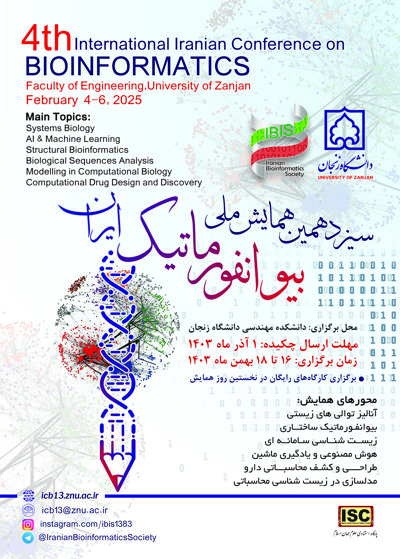
the 4th international edition and 13th Iranian Conference on Bioinformatics
international edition and Iranian Conference on Bioinformatics
صفحه اصلی
/
4th international edition and 13th Iranian Conference on Bioinformatics
A Fuzzy Bayesian Network Model for Personalized Diabetes Risk Prediction: Integrating Lifestyle, Genetic, and Environmental Factors
نویسندگان :
Lida Hooshyar
1
Nadia Tahiri
2
1- Graduate researcher (IASBS)
2- Assistant Professor, Department of Computer Science, University of Sherbrooke.
کلمات کلیدی :
Disease risk prediction،Gene-Environment interactions،Fuzzy Bayesian networks،Fuzzy clustering
چکیده :
This study introduces a novel Fuzzy Bayesian Network (FBN) model for predicting diabetes risk by integrating hereditary traits, environmental influences, and personal lifestyle data. Traditional Bayesian networks, which use Boolean logic and set theory, have limitations in handling the complexity and uncertainty of real-world health data. Boolean logic relies on rigid true/false classifications, which oversimplify relationships between variables. Similarly, set theory groups different samples into the same category, failing to capture their differences. These limitations hinder the accurate representation of overlapping and uncertain data. The proposed FBN model overcomes these challenges by assigning unique fuzzy membership degrees to each sample, ensuring distinct representation. The methodology applies the chain rule and Markov Chain Monte Carlo (MCMC) methods to model complex interactions among variables like age, weight, genetic traits, exercise, and sugar intake, addressing both intrinsic and extrinsic diabetes risk factors. Fuzzy membership functions quantify the degree of belonging to fuzzy sets, with these membership degrees acting as weights in the network. By combining these weights with probabilistic values, the model handles uncertainties and improves prediction accuracy. Genetic information is clustered using fuzzy c-means, simplifying the network while preserving essential variability. Compared to traditional binary models, the FBN offers advantages in managing uncertainty and providing probabilistic risk assessments. Boolean models, limited to rigid true/false relationships, fail to capture the complexities of health data, which often exist on a continuum. Results show that FBN delivers more accurate and flexible predictions, making it valuable for early detection, personalized risk assessment, and preventive care strategies. This adaptable model holds potential for application in other chronic disease research and clinical settings.
لیست مقالات
لیست مقالات بایگانی شده
In Silico Design of DNA G-Quadruplex Aptamers Targeting Lipopolysaccharide Core and Capsular Polysaccharide in Multidrug-Resistant Klebsiella pneumoniae
Aida Arezoumandchafi - Maryam Azimzadeh Irani - Hamidreza Mollasalehi
Integrated bioinformatic analysis for the screening of hub genes & therapeutic drugs in high-grade serous ovarian cancer
Maryam Khalili - Behnaz Saffar
3D modeling of the spike protein in the Omicron variant of the coronavirus and comparison with the Delta and Wuhan strains
Ali Abolhasanzadeh Parizi
Computational Screening of Signal Peptides for Optimized Secretory Production of Recombinant Lutheran b (Lub) Blood Group Antigen in Human Cell Lines
Kosar Asadi - Maryam Latifi - Mansoureh Shahbazi Dastjerdeh
"Molecular Docking Study of Natural Compounds from Daucus carota as Inhibitors of VEGFR-2: A Computational Approach for Drug Design"
MohammadMoein Bashi Mehrizi - Seyed Mohammad Mahdi Mortazavian - Hossein Hadavand Mirzaei
Discovery of effective markers in the severity of the disease in the genome of Iranian patients with covid-19 and introduction of an effective plant in controlling the severity of the disease
Fariba Esmaeili - Dariush Salimi
A Computational Approach to Identify Potent Inhibitors of Janus Kinase 1 from Natural Products: Structure-Based High-Throughput Virtual Screening and LightGBM Classifier.
Parisa Valipour
Identification of Therapeutic Biomarkers in Patients with Rheumatoid Arthritis Treated with Methotrexate
Narges Yaghoobi - Tannaz Araei - Sara Abedi - Mohsen Goharinia - Mohammad Mehdi Naghizadeh
Predicting Adverse Drug Reactions with Advanced Machine Learning Techniques
AlI Mohammadian - Sara Haghighi Bardine - Fatemezahra Alizade
Investigating the Role of EMT genes in Multiple Myeloma: A Bioinformatic Approach
Seyedeh Zahra Mousavi - Hamid Mahdizadeh - Mehdi Totonchi
بیشتر
ثمین همایش، سامانه مدیریت کنفرانس ها و جشنواره ها - نگارش 44.5.0